How Fake Reviews Are Destroying E-Commerce Trust — And What the Industry Gets Wrong About Fixing It
Published on 7 May 2026
Published by Veritatrust
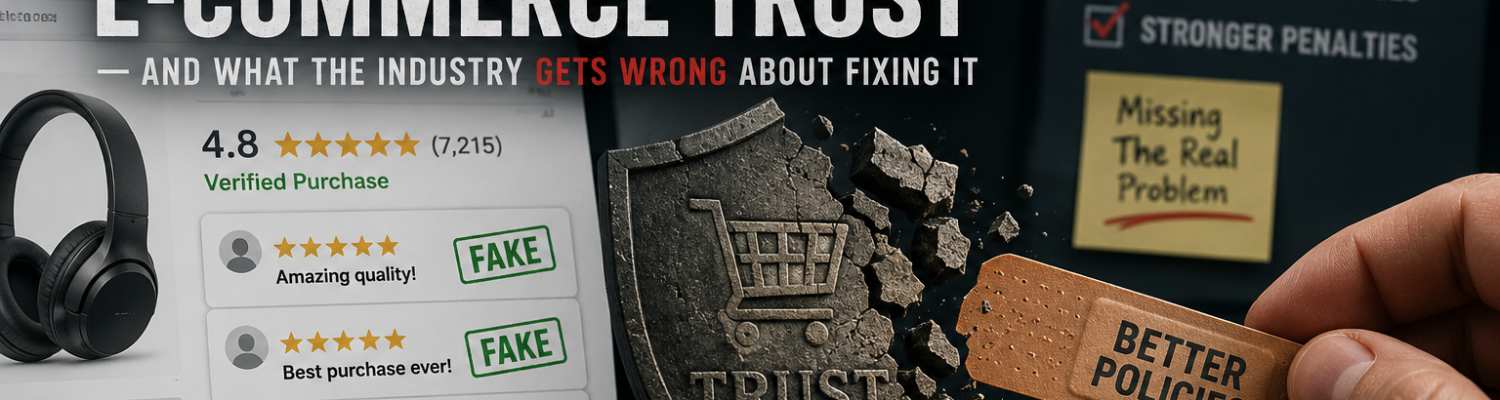
The number that should concern every e-commerce brand
93% of consumers read reviews before buying. Reviews influence purchase decisions more than price, delivery speed, and brand reputation combined. For most online stores, the review section is the single highest-converting element on any product page.
Now consider this alongside it: 85% of consumers suspect reviews are fake "sometimes or often."
This is the central contradiction of modern e-commerce. The most powerful trust signal in the industry — and the majority of consumers already doubt it.
54% of consumers will not complete a purchase if they suspect fake reviews are present. 62% actively avoid brands they believe censor or manipulate reviews.
These numbers represent an enormous amount of lost revenue. Not theoretical lost revenue — actual customers who landed on your store, read your reviews, and left without buying because the system gave them no way to know whether what they were reading was real.
The brands losing that revenue are mostly not the ones buying fake reviews. They are legitimate brands with genuine customers and real social proof — whose honest reviews sit next to manipulated ones in a system that gives buyers no way to distinguish between them.
That is the real fake review problem. And it is significantly bigger than most brands realise.
What fake review operations actually look like in 2026 ?
It is worth being precise about what we mean when we talk about fake reviews — because the problem is more varied and more sophisticated than most people outside the industry understand.
Review farms — organised networks of paid reviewers who submit positive reviews at scale, often across multiple platforms simultaneously. These operations have become industrialised. Some offer guaranteed delivery of hundreds of verified-looking reviews within 48 hours for a few hundred euros.
Competitor negative campaigns — coordinated fake one-star review attacks against competing brands. A single organised campaign can damage years of reputation building in days. The target brand has almost no recourse under the current system.
Review gating — the practice of only routing satisfied customers to public review platforms while steering dissatisfied customers to private feedback channels. This inflates public ratings artificially without technically submitting a single fake review.
AI-generated reviews — the newest and fastest-growing category. Large language models can generate hundreds of convincing, varied, contextually appropriate reviews in minutes. The scale this enables makes previous forms of review manipulation look artisanal.
Hijacked listings — fake reviews appearing on counterfeit product listings that exploit a legitimate brand's name and reputation. The original brand has no relationship with the reviewer and no control over the content.
Each of these operates differently. Each exploits a different gap in the current system. And crucially — each of them is primarily addressed by the same approach: detection after the fact.
Why detection is the wrong solution to the right problem
The review industry's response to fake reviews has been, almost universally, to get better at detecting them after submission.
More sophisticated algorithms. Larger human moderation teams. AI-powered pattern recognition. Third-party verification services that audit existing review pools.
These efforts are not worthless. They catch a meaningful percentage of fake reviews and they make manipulation more expensive. The regulatory momentum — the UK's Competition and Markets Authority making fake reviews a banned practice under the DMCCA 2024, BEUC pushing for stronger verification standards across Europe — adds real enforcement teeth.
The honest limitation is structural, not technical.
Detection is always reactive. You are looking for something after it has already appeared. And the incentive to game the system never disappears — which means as detection improves, manipulation evolves. It is an arms race that the platform, by definition, can never permanently win.
There is also a conflict of interest that rarely gets named directly. Review platforms have a commercial relationship with the brands they review. More reviews mean more engagement, more platform activity, and more revenue. The platform's business model is not perfectly aligned with eliminating every fake review — even when the platform is acting in complete good faith.
This is not a conspiracy. It is an architectural reality. The platform sits between the brand and the buyer, intermediating trust — and collecting a commercial benefit for doing so.
Any system built on that architecture will have this limitation built into it.
The problem most legitimate brands don't know they have
Here is the version of the fake review problem that almost never gets discussed.
You run a legitimate e-commerce store. You have genuine customers. You collect honest reviews through a reputable platform. You have never bought a fake review and never would.
And you are still losing sales to the fake review problem.
Because buyers cannot tell the difference.
Your genuine five-star review from a real customer looks identical to a planted one on every major review platform. Same format. Same badge. Same "verified buyer" label — which, on most platforms, simply means someone placed an order, not that the review itself is trustworthy.
When a sceptical buyer — the hardest buyer to convert, and often the highest-value one — looks at your review section and thinks "how do I know these are real?", the current system gives them no answer. There is no independent proof. There is only the platform's assurance that it checked.
Trusting the platform's assurance is not the same as being able to verify the truth independently. And an increasing number of buyers know the difference.
This is the commercial cost of the fake review epidemic that falls disproportionately on honest brands. The cheats get the benefit of doubt in a system with no verification. The honest brands lose the benefit of doubt for the same reason.
The AI dimension: why this problem is about to get significantly worse
There is a layer to the fake review problem that is only beginning to be understood by most e-commerce operators — and it will become one of the most significant competitive factors in the industry over the next two to three years.
AI-powered search is changing how consumers discover products.
When someone asks ChatGPT, Perplexity, or Google AI Overviews "what do customers say about [brand]?" — the AI reads reviews to answer. It synthesises them. It cites them. It uses them to form a recommendation.
And it has no reliable way to distinguish verified reviews from fake ones.
Right now, a brand with 500 AI-generated fake five-star reviews can appear more trustworthy in an AI-generated recommendation than a brand with 50 genuine ones. The AI is reading the same unverified review pool that sceptical buyers already distrust — and scaling the problem by surfacing it in response to millions of queries.
The brands that build verified, structured, blockchain-anchored review infrastructure now are building an AI search advantage that competitors using traditional review platforms cannot replicate. Not because the technology is complicated — but because the proof is independent. Any AI system can verify the review's provenance without trusting the platform's claim.
This is the forward-looking dimension of the fake review problem that most brands are not yet thinking about. The window to build this advantage early is real and it is finite.
What actually fixes it: verification at the source
The solution to a structural problem cannot be a detection layer. It has to be an architectural change.
The architectural change is this: verify the review at the moment of submission, not in the clean-up operation afterwards.
If a review is cryptographically anchored on-chain at the moment it is written — tied to a verified purchase record, timestamped, sealed — then the question "is this review real?" has an answer that does not require trusting any platform's claim. Any buyer can check. Any AI system can verify. The proof exists independently of the brand, the platform, and VeritaTrust.
This is what blockchain verification provides that no detection system can: not a better guess about whether a review is genuine, but mathematical proof that it is.
🔗 A review is real — tied to a verified purchase record
⏱️ It is timestamped — the exact moment of submission recorded on-chain
🔒 It cannot be altered — by anyone, including the platform
For legitimate brands — the ones doing everything right in a broken system — this changes the question buyers ask. Not "should I trust this platform?" but "I can verify this myself."
That shift, from platform-mediated trust to independently verifiable proof, is the structural fix the industry has been missing since the first fake review was submitted.
The question worth asking about your store
Most e-commerce brands reading this have never looked at their own reputation the way a sceptical buyer sees it.
Not through their own eyes — through the eyes of someone who has been burned by fake reviews before, who types their brand name into an AI assistant, and who wants proof rather than assurance.
What does that person find?
Are your reviews independently verifiable — or do they rely on the platform's word?
When AI search synthesises your review data — does it find structured, verifiable proof, or an unverified pool indistinguishable from manipulation?
If a competitor ran a negative review campaign against your store this week — could you prove to a buyer that your real reviews are genuine?
For most stores, the honest answer to all three is no.
That is not a reflection of their integrity. It is a reflection of the system they are operating in.
VeritaTrust exists to change those answers — not by adding another detection layer on top of a broken architecture, but by building the trust infrastructure layer underneath it.
See it on a live store
Rather than take our word for it, the best way to understand what blockchain-verified reviews look like in practice.
If you want to understand what your store's e-reputation actually looks like to buyers and AI systems right now — our founder offers a free 30-minute live audit. A genuine look at what the data shows about your store's trust infrastructure, and where it may be costing you sales.
VeritaTrust is the trust infrastructure layer beneath reviews and social proof — blockchain-verified, AI-indexed, tamper-proof. Built for e-commerce brands whose reputation should be provable, not just claimable.
Featured Posts
Categories
- E-commerce (5)